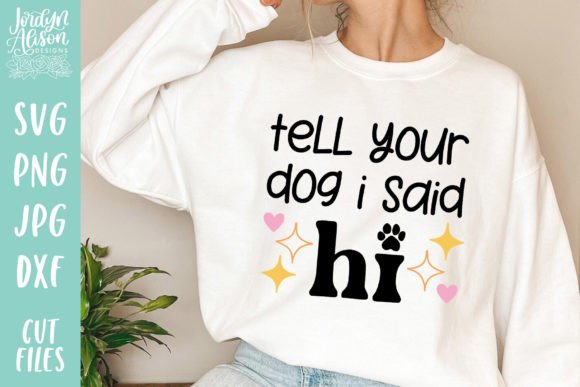
Tell Your Dog I Said Hi SVG Graphics and Crafts Review
When a client approaches me with a request for a handmade brand identity, my first instinct is to look beyond the obvious. They often want something that feels personal, warm, and deeply connected to their lifestyle. Recently, I was reviewing assets for a boutique pet accessories line—a small business owner who wanted to launch a seasonal collection of wood signs and embroidered t-shirts. The brief was specific: the design needed to convey affection without being overly sentimental or cluttered. This is where Tell Your Dog I Said Hi SVG caught my attention. As a graphic designer, I am constantly filtering through digital products to find assets that offer professional polish rather than generic clipart. In this review, I will break down how this specific design asset performs in a real-world commercial context, examining its visual hierarchy, versatility, and suitability for both digital marketing visuals and physical production.
First Impressions and Visual Mood
The immediate appeal of this dog mom SVG lies in its balance of playful typography and clear intent. When you open the file, you are not greeted by a complex illustration that demands heavy editing; instead, you receive a clean, cohesive typographic arrangement. For a brand identity project, simplicity is often the hardest thing to achieve. This design succeeds because it relies on strong letterforms that read instantly. The mood it creates is inviting and casual, perfectly suited for a handmade business or a small shop selling personalized gifts. It does not scream for attention like a bold display font might; rather, it whispers a friendly greeting, which is exactly what emotional appeal requires in lifestyle branding.
In terms of style, the asset leans towards modern design principles with a touch of whimsy. It fits naturally into collections that feature earth tones, pastel palettes, or rustic aesthetics. If your client is aiming for a high-end corporate logo design, this would likely be too informal. However, for social media graphics, Instagram posts, or Pinterest pins targeting pet owners, the visual trust it builds is significant. It signals to the audience that the brand understands the culture of dog ownership—casual, loving, and community-focused.
Performance in Real Design Situations
Let us look at how this SVG design translates across various mediums. A common mistake designers make is assuming a vector file looks good on screen but fails in print. Here, the structural integrity of the lines suggests it holds up well under scrutiny. For product mockups, such as tote bags or mugs, the text remains legible even when curved or wrapped around cylindrical shapes. This is crucial for packaging design, where space is limited and clarity is paramount.
Consider the application for a sticker design. Stickers require precise cut lines and high contrast. Because this asset includes an SVG file alongside PNG and DXF formats, it offers flexibility. The SVG allows for infinite scalability, meaning you can resize the graphic for a large banner ad or shrink it down for a tiny laptop decal without losing edge quality. In editorial design, such as a blog post about pet care, this image serves as an engaging header that breaks up text blocks effectively. It adds personality to web design without overwhelming the content.
For crafters using Cricut projects or Silhouette cutting machines, the DXF and SVG files are particularly valuable. These formats ensure that the cutting blade follows the exact contours of the letters, resulting in clean edges on vinyl, wood, or cardstock. When creating wood signs, the negative space between letters becomes part of the design’s rhythm. A poorly constructed vector might leave awkward gaps or merge unexpectedly during the cutting process. This asset appears to have been crafted with those technical constraints in mind, reducing the need for manual node editing in software like Adobe Illustrator.
Where the Asset Shines
This design asset works best when given room to breathe. Large layout areas, such as hero graphics on a landing page or the front face of a product box, allow the typography to establish itself as the focal point. It is also excellent for decorative accents in themed collections. Imagine a series of four seasonal signs, each featuring a different phrase from a similar bundle; this particular design would anchor the "spring" or "summer" campaign beautifully. It performs exceptionally well in printable designs, such as wall art or greeting cards, where the emotional connection between the viewer and the message is the primary goal.
Furthermore, its versatility extends to sublimation design. Whether printing on polyester fabrics for athletic wear or ceramic mugs, the clean lines of the SVG translate well to dye-sublimation processes. It avoids the muddy artifacts that can plague intricate illustrations when printed at lower resolutions. For Etsy product listings, having a high-quality preview of this design on a mockup can significantly increase click-through rates, as customers can visualize the final result clearly.
Areas Requiring Careful Consideration
No single asset is perfect for every scenario. There are contexts where Tell Your Dog I Said Hi SVG should be used carefully. In minimalist branding, where every pixel must earn its place, this design might feel slightly busy if paired with other decorative elements. If your client’s brand identity relies on strict geometric forms and sans serif fonts, this more organic style could clash visually. Additionally, in crowded layouts or complex backgrounds, the text may lose its impact. Always test the design against low-contrast backgrounds; dark colors on dark wood, or light colors on white paper, can render the message unreadable.
It is also important to consider the scale. While vectors scale infinitely, readability has limits. At very small sizes, such as a favicon or a tiny icon in a navigation bar, the details of the lettering may blur together. In these cases, it is better to use a simplified version or a different graphic element entirely. For professional corporate materials, this asset is likely inappropriate due to its informal tone. It lacks the gravitas required for legal, financial, or medical branding.
Practical Designer Notes for Commercial Use
Before integrating any creative design into a client project, a rigorous quality check is non-negotiable. First, convert the asset to black and white. This removes the distraction of color and reveals whether the visual hierarchy stands on its own. If the design loses impact without color, it may rely too heavily on styling rather than structure. Next, check the contrast on both light and dark backgrounds. Ensure that the kerning (spacing between letters) remains consistent and does not create unintended words or awkward gaps.
Preview the asset at various sizes. Zoom out until it is thumbnail-sized and zoom in until it is billboard-sized. Does it hold up? Inspect the PNG transparency if included; jagged edges around the curves indicate a low-resolution raster export, which should be avoided for print-on-demand services. Review the file formats provided. Having an SVG file is essential for editability, allowing you to adjust stroke weights or modify paths if necessary. Compare this design with other styles, such as script fonts or handwritten fonts, to ensure it aligns with the overall aesthetic direction. If the client prefers a serif font for elegance, this asset might feel disjointed unless balanced carefully.
Finally, confirm the commercial license. Many digital products come with restrictions on how they can be used in end products. Ensure you have the right to sell physical items made with this design. This protects both you and your client from copyright infringement issues. By taking these steps, you transform a simple download into a polished, professional component of a larger brand strategy.
Final Verdict
Tell Your Dog I Said Hi SVG is a reliable, versatile graphic design asset that brings warmth and clarity to lifestyle-oriented projects. It is ideal for small business branding, handmade businesses, and creative marketplaces where authenticity matters. While it may not suit every corporate or minimalist aesthetic, its strength lies in its ability to connect emotionally with audiences who value pets and personal expression. For designers looking to add a touch of personality to merchandise, social media graphics, or printable designs, this asset is a worthy addition to their toolkit. Just remember to test it thoroughly, respect its limitations, and always prioritize the client’s broader brand goals.